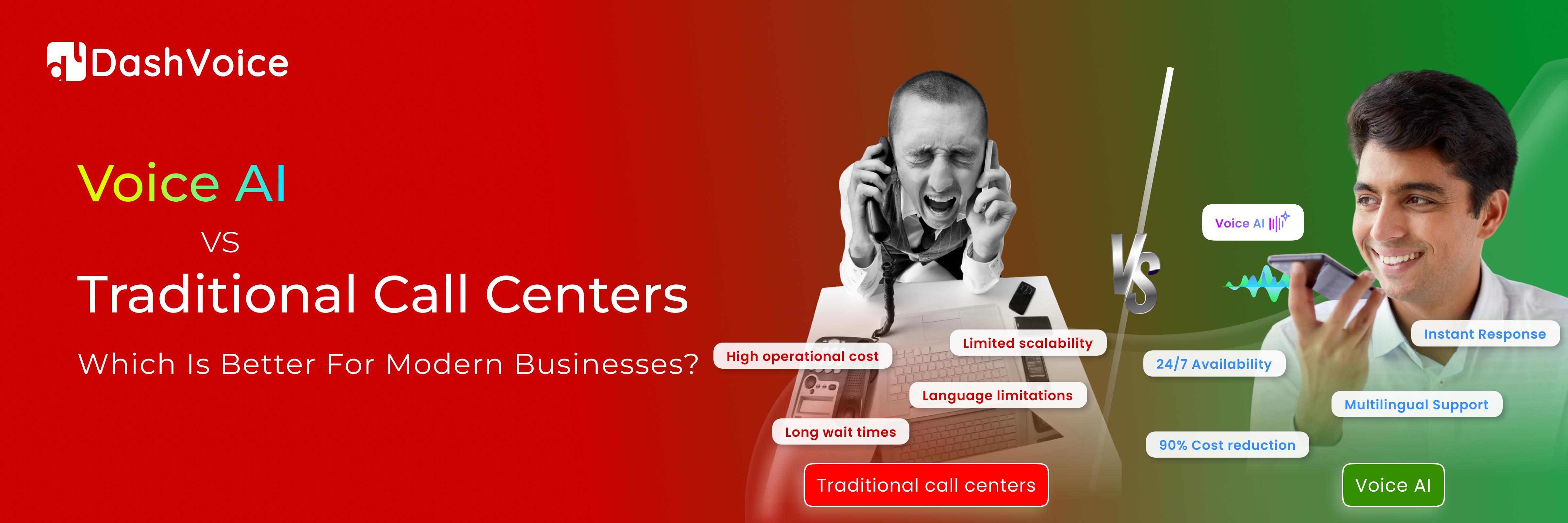
Voice AI vs Traditional Call Centers: Which Is Better for Modern Businesses?

Voice AI vs Traditional Call Centers: Which Is Better for Modern Businesses?
Voice AI vs Traditional Call Centers
As customer expectations evolve, businesses are rethinking how they deliver support and engagement. Voice AI and traditional call centers each offer unique advantages—but which is better for modern businesses?

In this guide, we break down the differences, benefits, and ideal use cases to help you choose the right approach for your customer experience strategy.

Introduction

If you’ve ever been stuck on hold listening to “your call is important to us,” you already know the biggest problem with traditional call centers.
They work—but not always when you need them to.
Now compare that to calling a business and getting an instant, accurate response within seconds, without waiting or repeating yourself.
That’s the experience voice AI is starting to deliver.
So the real question for modern businesses isn’t whether to upgrade, but what to choose: voice AI or traditional call centers?
Let’s break it down in a practical, no-nonsense way.

What Are Traditional Call Centers?

Traditional call centers rely on human agents to handle customer interactions over phone calls.
They’ve been the backbone of customer support for decades and are still widely used for:
  • Handling customer queries
  • Resolving complaints
  • Providing product information
  • Managing inbound and outbound calls
They bring a human touch—but also come with limitations in speed, scalability, and consistency.

What Is Voice AI?

Voice AI uses conversational AI, speech recognition, and natural language processing (NLP) to automate voice-based interactions.
Instead of waiting for an agent, customers interact with an AI voice assistant that can:
  • Understand spoken language
  • Respond instantly
  • Handle multiple conversations simultaneously
  • Operate 24/7 without downtime
With advancements in generative AI, these systems are far more natural and context-aware than traditional IVR systems.

Voice AI vs Traditional Call Centers: The Real Comparison

1. Speed and Availability

Traditional call centers are limited by working hours, agent availability, and call queues.

Voice AI is always available and can handle thousands of calls simultaneously without putting customers on hold.

Winner: Voice AI

2. Cost and Scalability

Traditional call centers require significant investment in hiring, training, infrastructure, and operations.

Voice AI scales without increasing headcount, making it more cost-efficient for growing businesses.

Winner: Voice AI

3. Customer Experience (CX)

Traditional call centers offer human empathy and better handling of complex issues but often suffer from long wait times and inconsistency.

Voice AI delivers instant, consistent responses but may struggle with emotional or complex situations.

Best Approach: Hybrid (AI + Humans)

4. Consistency and Accuracy

Human responses can vary, especially under pressure or high call volumes.

Voice AI ensures standardized, accurate, and consistent communication.

Winner: Voice AI

5. Data and Insights

Voice AI automatically captures, transcribes, and analyzes conversations to generate insights.

This helps businesses understand customer intent, common issues, and buying behavior.

Winner: Voice AI

6. Multilingual and Omnichannel Support

Voice AI makes it easier to support multiple languages and integrate across channels like WhatsApp, apps, and web chat.

Traditional call centers can achieve this—but with higher cost and effort.

Winner: Voice AI

Where Traditional Call Centers Still Make Sense

Despite the advantages of AI, traditional call centers remain essential for:
  • Complex problem resolution
  • Emotional or sensitive conversations
  • High-value customer interactions
Human agents are still critical where empathy, judgment, and relationship-building are required.

So, Which Is Better for Modern Businesses?

The answer isn’t choosing one over the other—it’s combining both.

Use voice AI for:

  • Repetitive queries
  • First-level support
  • High-volume interactions

Use human agents for:

  • Complex issues
  • Escalations
  • Relationship-building

This hybrid approach delivers:

  • Speed + empathy
  • Efficiency + personalization
  • Automation + human touch

The Bigger Shift: From Support to Experience

Customer support is no longer just about solving problems—it’s about delivering seamless and helpful experiences.
Conversational AI and voice assistants are enabling businesses to communicate, engage, and grow more effectively.
They are not just reducing costs—they are transforming customer experience (CX).

Conclusion

Traditional call centers built the foundation of customer support.
But voice AI is redefining what’s possible.
The goal isn’t to replace humans—it’s to remove friction.
Faster responses, better insights, and smarter conversations are what customers expect today.
Businesses that adopt AI-powered customer service and voice automation will be better positioned to stay ahead in a competitive market.