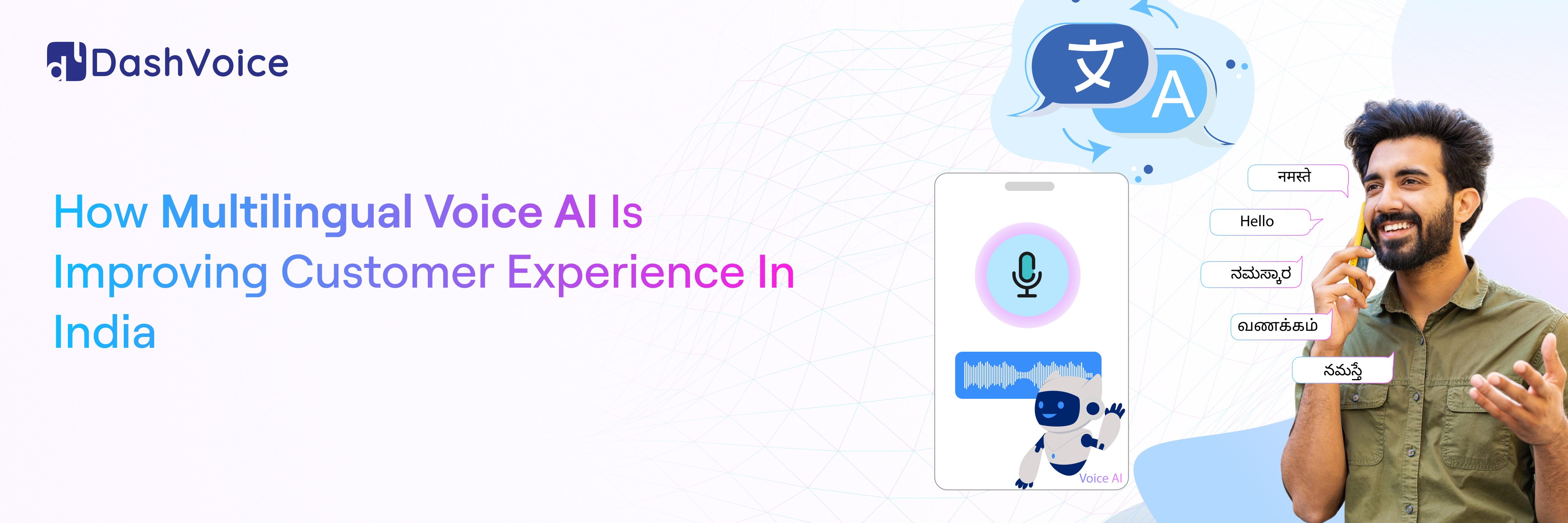
Multilingual voice AI is transforming how businesses connect with customers in India by enabling natural, language-first interactions.
In a country defined by linguistic diversity, voice AI helps businesses deliver inclusive, accessible, and personalized customer experiences at scale.
In a country defined by linguistic diversity, voice AI helps businesses deliver inclusive, accessible, and personalized customer experiences at scale.
Introduction
If you’ve ever tried explaining something in a language you’re not fully comfortable with, you know how frustrating it can be.
Now imagine that experience when you’re trying to interact with a business—ask about a product, raise a complaint, or get support.
That’s the reality for millions of people across India.
With so many languages, dialects, and cultural nuances, communication has always been a major challenge.
This is exactly where multilingual voice AI is making a real difference.
It’s not just about technology—it’s about making conversations feel natural, comfortable, and accessible.
Why Language Matters So Much in India
India is one of the most linguistically diverse countries in the world:
- 20+ officially recognized languages
- Hundreds of regional dialects
- Millions of people more comfortable speaking than typing
While English and Hindi are widely used, a large portion of the population prefers regional languages.
This creates a gap:
- Customers want to communicate in their own language
- Businesses struggle to support this at scale
This gap directly impacts customer experience (CX).
What Is Multilingual Voice AI?
Multilingual voice AI uses conversational AI, natural language processing (NLP), and speech recognition to interact in multiple languages.
Instead of forcing customers to adapt, the system adapts to them.
Modern AI voice assistants can:
- Understand different languages and accents
- Switch between languages seamlessly
- Respond naturally in regional languages
- Maintain context across conversations
This makes interactions smoother and more inclusive.
How Multilingual Voice AI Is Improving Customer Experience
1. Customers Can Speak in Their Preferred Language
Customers no longer need to struggle with unfamiliar languages or simplify their queries.
They can communicate naturally—leading to higher comfort and satisfaction.
2. More Inclusive and Accessible Support
Voice AI removes barriers for users who are not comfortable typing or navigating apps.
This is especially valuable for:
- Non-English speakers
- First-time internet users
- People in Tier 2 and Tier 3 cities
3. Better Understanding of Customer Intent
AI systems can interpret regional phrasing and conversational nuances.
This reduces misunderstandings and improves overall CX.
4. Faster Response Times Across Regions
Multilingual AI handles multiple languages simultaneously and provides 24/7 support.
This ensures faster and consistent service across geographies.
5. Stronger Customer Trust and Engagement
When businesses communicate in a customer’s language, it builds trust and emotional connection.
This leads to higher engagement, better interactions, and improved conversions.
Real Impact Across Industries
Retail
- Product discovery in local languages
- Better in-store and phone interactions
Banking & Financial Services
- Simplifies complex conversations
- Builds trust with regional customers
Customer Support
- Handles multilingual queries
- Reduces dependency on large teams
Healthcare & Services
- Improves clarity in communication
- Enhances accessibility for non-English speakers
Why Multilingual Voice AI Is Critical for India’s Future
India’s next phase of digital growth is driven by regional users and non-metro cities.
These users:
- Prefer voice over typing
- Prefer local languages over English
- Expect simple and fast interactions
Businesses that fail to adapt risk missing a large market opportunity.
By investing in multilingual voice AI, companies can expand reach, improve CX, and stay competitive.
Challenges to Keep in Mind
While powerful, multilingual voice AI comes with challenges:
- Handling diverse accents and dialects
- Training AI for regional nuances
- Ensuring data privacy and compliance
- Integrating with existing systems
However, rapid advancements in AI and NLP are making these easier to address.
What’s Next?
The future of multilingual voice AI includes:
- More human-like conversations
- Better emotional and tone recognition
- Deeper integration with business systems
Voice will become a primary interface for customer interaction.
Conclusion
In a diverse country like India, language should never be a barrier.
Multilingual voice AI is becoming essential for delivering inclusive and effective customer experiences.
It helps businesses:
- Connect better with customers
- Reach a wider audience
- Provide faster and personalized support
When customers can speak comfortably, they engage more.
When they engage more, they trust more—and that drives business growth.